
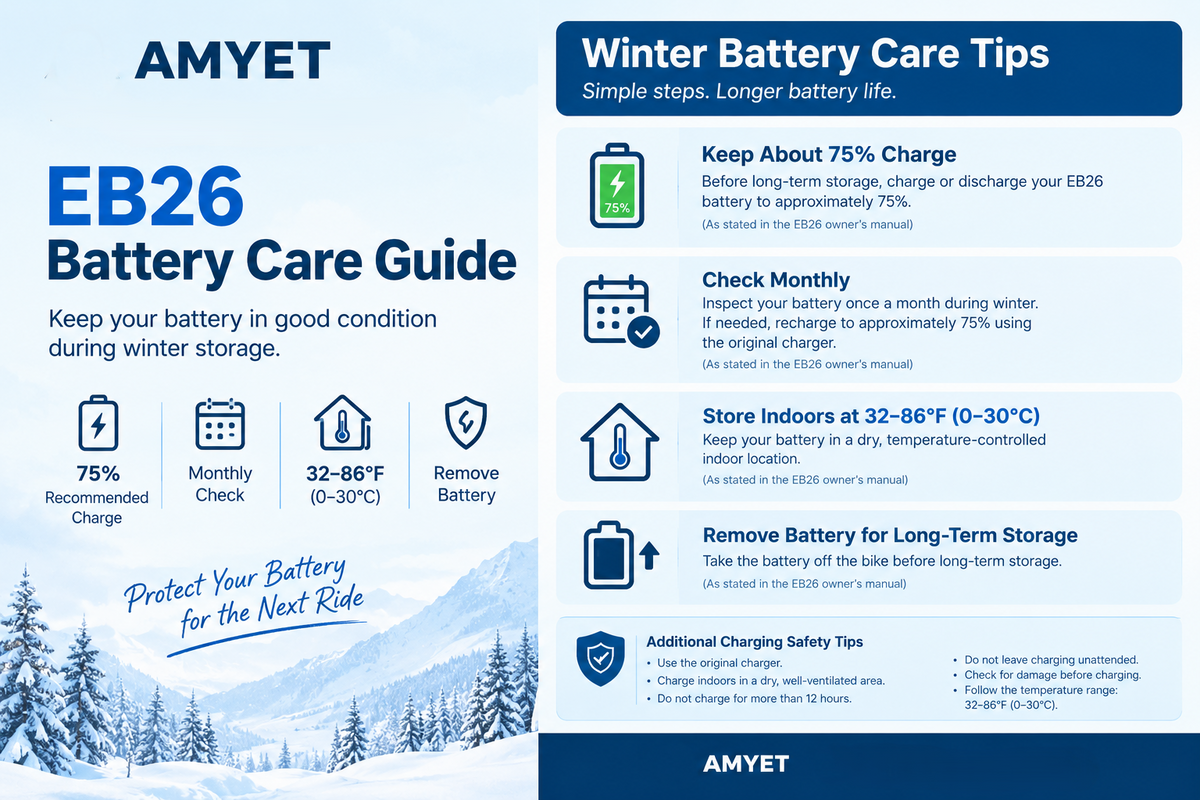
How to Store Your E-Bike Battery for Winter: AMYET EB26 Battery Care Guide

Getting Your AMYET EB26 Ready for Winter
As temperatures drop, many riders across the United States put their electric bikes away until spring. You might clean your AMYET EB26, park it in the garage, and look forward to getting back on the road when warmer weather returns.
But before you put your e-bike away, there's one important thing you shouldn't forget: your battery needs proper care even when you're not riding.
One common battery maintenance mistake is storing an e-bike for several months without checking its charge level. Although lithium-ion batteries naturally lose some charge over time, leaving a battery at a very low charge level for an extended period can cause over-discharge and potentially permanent damage.
When spring arrives, you may discover that your battery won't charge, your display won't turn on, or your e-bike won't provide power.
The good news? A few simple habits can help protect your AMYET EB26 battery throughout the winter.
In this guide, we'll explain how to prepare your battery for long-term storage, maintain the recommended charge level, and reduce the risk of battery problems when riding season returns.
1. Why Is E-Bike Battery Over-Discharge a Problem?
The AMYET EB26 uses a rechargeable lithium-ion battery. Like other lithium-ion batteries, it needs proper care during periods of extended inactivity.
Over-discharge occurs when a battery's voltage falls below the safe operating range of its cells. This can happen when a battery is stored with very little charge and continues to lose energy over time.
Even when your e-bike is switched off, a battery can gradually lose charge through natural self-discharge. Depending on the electrical system, leaving the battery installed may also allow some components to draw a small amount of standby power.
If you store your battery for months without checking it, its charge level may eventually fall too low.
Potential consequences include:
-
Charging problems: The battery may not accept a normal charge if its voltage falls outside the permitted range.
-
Power issues: The display may not turn on, or the motor may not receive power.
-
Reduced battery capacity: Excessive discharge can damage lithium-ion cells and shorten battery life.
-
Permanent battery damage: In severe cases, the battery may no longer be recoverable through normal charging.
A battery that won't charge isn't necessarily over-discharged. A faulty charger, damaged connection, battery management system (BMS) protection, or another electrical issue can cause similar symptoms.
That's why prevention matters. Following the correct storage procedure can help reduce the risk of avoidable battery problems.
2. Store Your AMYET EB26 Battery at Approximately 75% Charge
One of the most important recommendations in the AMYET EB26 owner's manual is to prepare the battery for long-term storage at approximately 75% charge.
This differs from the charge level you might use for everyday riding. For winter storage, the goal is to maintain a suitable charge level rather than leaving the battery completely empty or fully charged for months.
Before storing your EB26 for an extended period:
-
Check the current battery charge level.
-
Charge or discharge the battery as needed to reach approximately 75%.
-
Switch off the battery and e-bike.
-
Disconnect the charger when charging is complete.
-
Remove the battery from the bicycle before storage.
If your battery is nearly empty, don't simply put the bike away and plan to charge it in the spring.
Important: The approximately 75% recommendation applies to long-term storage of the AMYET EB26 as specified in its owner's manual. If you own a different AMYET model, follow that model's battery storage instructions.
3. Check Your Battery Every Month During Winter
This is one of the easiest and most important ways to help prevent battery over-discharge.
Many riders prepare their e-bikes in late fall and don't think about them again until spring. Unfortunately, a battery can gradually lose charge while sitting unused.
The AMYET EB26 owner's manual recommends checking the battery once a month during long-term storage.
Here's what to do:
-
Check the battery's charge level or indicator.
-
Inspect the battery for visible damage, moisture, swelling, or unusual odors.
-
If necessary, recharge the battery to approximately 75% using the original charger.
-
Disconnect the charger after charging is complete.
-
Set a reminder for your next monthly inspection.
You don't need to recharge the battery to 100% every month. The goal is to maintain approximately 75% charge during long-term storage, following the instructions in the owner's manual.
For example, if you store your EB26 in November, check the battery again in December, January, February, and March if it remains in storage.
A simple calendar reminder can help you avoid forgetting about your battery for the entire winter.
AMYET tip: Don't wait until the display won't turn on or the charger indicator behaves unexpectedly. Regular battery checks are much easier than troubleshooting a battery that may have been deeply discharged.
4. Remove the Battery From Your EB26 Before Long-Term Storage
According to the AMYET EB26 owner's manual, the battery should be removed from the bicycle for long-term storage. Do not leave it installed on the frame.
Removing the battery also makes it easier to inspect and maintain it throughout the winter.
Before removing the battery:
-
Switch off the e-bike's electrical system.
-
Follow the owner's manual for the correct battery removal procedure.
-
Support the battery securely while unlocking and lifting it from the frame.
-
Inspect the battery housing and accessible contacts for visible damage or moisture.
-
Store the battery indoors in an appropriate environment.
Never force the battery out of its mounting system. Keep the battery terminals clean, dry, and free of debris.
If you notice damage, swelling, leakage, or other abnormal behavior, stop using and charging the battery. Do not open the battery housing or attempt to repair its internal cells yourself.
5. Store Your Battery Indoors at the Right Temperature
Winter weather can be hard on e-bike batteries. Extremely cold or hot conditions can affect battery performance and may cause damage if the battery is stored outside the permitted temperature range.
The AMYET EB26 owner's manual specifies the following storage conditions:
-
Temperature: 32–86°F (0–30°C)
-
Location: Indoors
-
Environment: Dry and temperature-controlled
A suitable indoor storage area is generally a better choice than an outdoor shed or a garage that regularly falls below freezing or experiences excessive heat.
Avoid extreme temperatures
Don't leave your battery near a furnace, heater, fireplace, or other heat source. Keep it away from direct sunlight and locations that become excessively hot.
Keep the battery dry
Protect the battery and its electrical contacts from moisture, condensation, and water. Do not charge or use a wet or visibly damaged battery.
Choose a safe storage location
Store the battery in a safe, well-ventilated area away from combustible materials and heat sources. Keep it away from children and pets.
Never cover the battery in a way that could trap heat, and never open the battery pack for maintenance.
Remember: The EB26 storage temperature range is 32–86°F. Don't assume that a cold garage is suitable simply because the bike is switched off.
6. Follow These Battery Charging Safety Rules
Proper charging is just as important as proper storage.
When charging your AMYET EB26 battery, follow the instructions in the owner's manual.
-
Use the original charger supplied with your bike. Do not use an incompatible charger.
-
Charge indoors in a dry, well-ventilated area.
-
Check the temperature: The specified charging temperature range is 32–86°F (0–30°C).
-
Inspect before charging: Check the battery, charger, cable, and charging port for visible damage.
-
Keep the charger uncovered: Place it on a hard, flat, open surface with its ventilation openings unobstructed.
-
Monitor charging: Never leave a battery charging unattended.
-
Avoid excessive charging time: The EB26 owner's manual states not to charge for more than 12 hours.
-
Disconnect after charging: Follow the manual's charging and disconnection procedure.
If your battery has been stored in a cold garage or shed, bring it into a suitable indoor environment and allow it to reach the permitted charging temperature naturally before charging. Never use direct heat to warm a battery quickly.
If the battery is damaged, has been dropped, was involved in a crash, or is behaving abnormally, stop using and charging it and contact AMYET support.
7. Common Winter Battery Storage Mistakes to Avoid
Even a well-maintained e-bike battery can run into trouble if a few basic precautions are overlooked.
Mistake #1: Storing the battery nearly empty
A low charge level leaves less room for natural self-discharge before the battery reaches an unsafe voltage.
What to do instead: Prepare the EB26 battery at approximately 75% charge before long-term storage.
Mistake #2: Forgetting to check the battery
Leaving your battery untouched from fall until spring means you won't know if its charge level has dropped.
What to do instead: Check the battery monthly and recharge it to approximately 75% when necessary.
Mistake #3: Leaving the battery installed on the bike
The EB26 owner's manual specifically instructs riders to remove the battery for long-term storage.
What to do instead: Switch off the system, remove the battery following the manual, and store it indoors.
Mistake #4: Storing the battery in a freezing garage
A garage that drops below 32°F may fall outside the EB26's specified storage temperature range.
What to do instead: Choose an indoor location that stays within 32–86°F (0–30°C).
Mistake #5: Charging a battery that shows signs of damage
A damaged or abnormal battery may present a safety risk.
What to do instead: Stop using and charging the battery and contact AMYET support for guidance.
8. What If Your AMYET EB26 Battery Won't Charge After Winter?
You take your EB26 out of storage, connect the charger, and discover that the battery won't charge. Perhaps the battery indicator doesn't illuminate, the charger light stays green, or the display won't turn on.
Don't panic, but don't keep attempting to charge the battery repeatedly without understanding the cause.
Step 1: Check for visible damage
If the battery is swollen, leaking, unusually hot, physically damaged, or emitting an unusual odor, stop using it. Do not charge it or attempt to repair it yourself.
Step 2: Inspect the charger and visible connections
If there are no signs of battery damage, inspect the charger, charging port, and visible connections for obvious damage or moisture.
Switch off and disconnect the equipment before inspecting connections. Do not force connectors or touch exposed electrical contacts.
Step 3: Have the battery voltage checked if necessary
If the battery has no charge indication or the bike won't power on, measuring the battery's output voltage may help identify the problem.
Voltage testing should only be performed by someone familiar with safe electrical testing and the correct test points. Never open the battery pack, short its terminals, or bypass its battery management system.
Step 4: Contact AMYET support
If the battery still won't charge or power the bike, contact AMYET customer support for further assistance.
When contacting support, provide:
-
Your EB26 model information.
-
Your order information, if available.
-
A description of the symptoms.
-
A short video showing the charger indicator and battery behavior, if it is safe to do so.
A battery that won't charge may have a charger problem, a connection issue, a protection-state issue, or internal battery damage. A deeply discharged battery may have suffered irreversible damage.
Never attempt to force-charge the battery or bypass its safety protection system.
9. Get Your AMYET EB26 Ready for Spring
When the weather warms up, take a few minutes to inspect your e-bike before heading out on your first ride.
Use this checklist:
-
Inspect the battery for visible damage.
-
Confirm that it charges normally according to the owner's manual.
-
Check the battery mount and accessible electrical connections.
-
Make sure the battery is securely installed.
-
Inspect the tires, brakes, lights, and other important components.
-
Take a short, cautious test ride in a safe area.
-
Monitor battery performance during your first few rides.
If the battery won't charge, shuts off unexpectedly, or shows significantly reduced range, stop using it if its behavior appears unsafe and contact AMYET support or a qualified technician.
Proper storage helps protect battery health, but it cannot reverse normal battery aging or guarantee that every battery will remain trouble-free.
AMYET EB26 Winter Battery Care Checklist
Before putting your e-bike away for the season, save this checklist and work through each step.
- Charge or discharge the battery to approximately 75%.
- Switch off the electrical system and remove the battery from the bicycle.
- Store the battery indoors at 32–86°F (0–30°C) in a dry, temperature-controlled location.
- Use only the original charger when charging is necessary.
- Set a reminder to inspect the battery once a month.
- Recharge to approximately 75% if necessary.
- Never leave a battery charging unattended.
- Inspect the battery before returning to regular riding in spring.
Bookmark this guide so you can refer to it whenever the riding season ends.
Frequently Asked Questions
What percentage should I charge my AMYET EB26 battery to before winter storage?
The AMYET EB26 owner's manual recommends charging or discharging the battery to approximately 75% before long-term storage.
How often should I check my e-bike battery during winter?
Check your EB26 battery once a month during long-term storage. If necessary, recharge it to approximately 75% using the original charger.
Can I leave my AMYET EB26 battery on the bike during winter?
The EB26 owner's manual instructs riders to remove the battery from the bicycle for long-term storage rather than leaving it installed on the frame.
What temperature is best for storing an AMYET EB26 battery?
The EB26 owner's manual specifies indoor storage at 32–86°F (0–30°C) in a dry, temperature-controlled location.
Why won't my e-bike battery charge after winter?
Possible causes include over-discharge, a charger or connection issue, BMS protection, or internal battery damage. Stop repeated charging attempts if the battery behaves abnormally, and contact AMYET support for assistance.
Should I leave my e-bike battery plugged in throughout the winter?
No. Follow the EB26 charging instructions, disconnect the charger after charging, and check the battery monthly during storage. Do not leave the battery charging unattended.
Final Thoughts: Take Care of Your Battery Before Winter Arrives
Your AMYET EB26 battery is one of the most important components of your electric bike. Although it doesn't require constant attention, it shouldn't be forgotten during months of winter storage.
The most important steps are simple:
-
Store the battery at approximately 75% charge.
-
Remove it from the bicycle for long-term storage.
-
Keep it indoors at 32–86°F (0–30°C).
-
Check the battery every month.
-
Recharge to approximately 75% when necessary, using the original charger.

Following these steps can help reduce the risk of over-discharge and keep your battery better prepared for the next riding season.
Getting ready to put your AMYET EB26 away for winter? Check your battery today—not when the weather warms up.
Share:
AMYET EB26 vs G60: Which Fat Tire Electric Bike Is Right for You?